Mobile app development for business
We design and develop mobile apps for company workflows — from standard connected products to field apps that cannot depend on constant connectivity. We integrate them with your existing systems and stay responsible through architecture, store release, and ongoing development.
Our mobile apps are used daily by field teams at:


What we specialize in
Online and offline-first
We build both standard connected apps and offline-first apps that work fully without internet — data is stored locally and synchronizes once the connection is back. We treat offline-first as an engineering decision, not a default: we use it when the workflow cannot depend on connectivity — in the field, in a warehouse, on a construction site.
iOS, Android, and Android TV from one codebase
A shared codebase reduces duplicated implementation across phones, tablets, and Android TV, helping us keep behavior consistent and release updates across all platforms.
Integration with your systems
Sign-in with a company account (SSO), integration with your APIs and backend systems, electronic document signing, and two-way synchronization. We design it around your existing identity, data, and document flows.
Publishing, maintenance, and support
We handle publishing to the App Store and Google Play, shipping updates, error monitoring, and end-user support requests.
What mobile apps we build
We specialize in apps for company workflows and field work — where reliability, system integration, and offline operation matter. Example use cases:
- Sales rep app
- Warehouse app
- Property handover app
- Field service app
- Audit app
- Technical inspection app
- Driver app
- Quality control app
- Inventory app
- E-signature app
- Manufacturing app
- Field reporting app
Property handover app for Echo Investment and Archicom
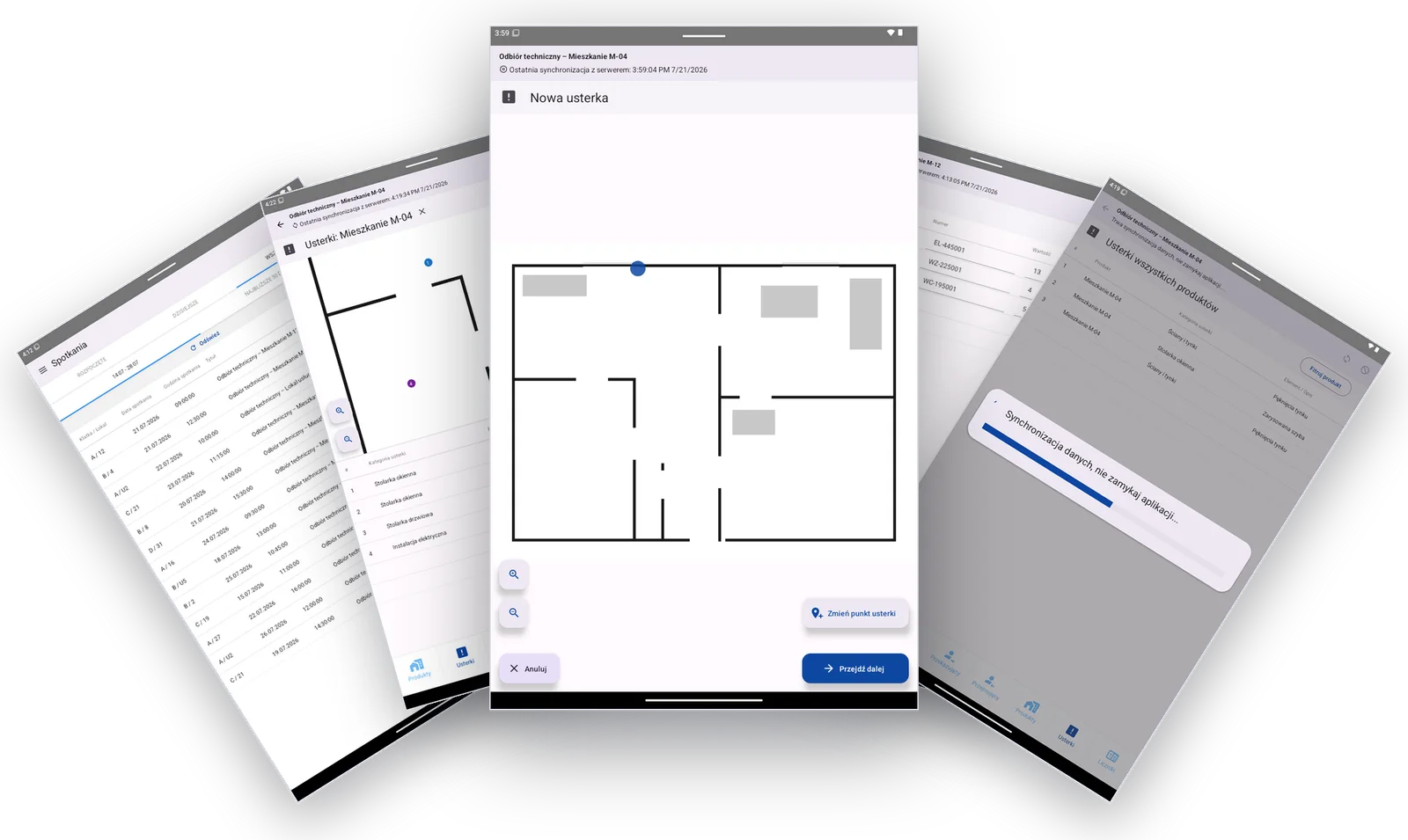
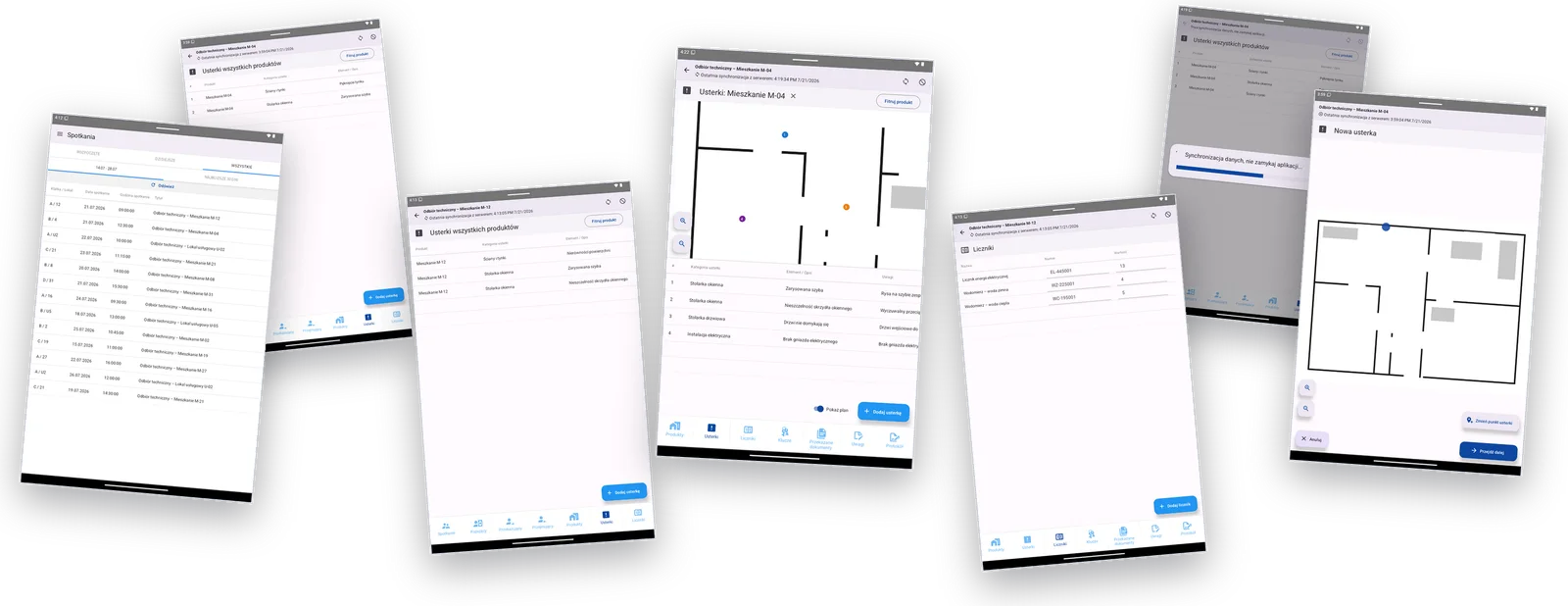
Field workers run apartment handovers on-site — often where the signal is weak or absent. During the meeting they mark defects on the floor plan, record meter readings and key handovers, collect GDPR consents, and finish with a handover report signed electronically. The key requirement: a worker must be able to carry out the inspection even with no signal.
Our approach
- → Offline-first architecture: capturing the inspection data runs locally, with no dependency on the network during the meeting.
- → Starting a meeting downloads all the data to the device; editing happens against a local database, and the data syncs back to the server afterwards.
- → Sign-in with a company account (SSO) and electronic signing of the handover report without leaving the app.
- → One codebase with separate, brand-tailored versions for each client.
Technical highlights
- The server maintains the authoritative state, and devices synchronize with it when connectivity returns.
- Synchronization runs in the background and can be deferred, so field work does not have to wait for data transfer.
- Company-account sign-in (SSO) integrated with the client's infrastructure.
- Interactive floor plan with defect markers; the PDF handover report is generated automatically and signed electronically in the app.
Outcome
- The app handles hundreds of apartment handovers a month across both developers’ field teams.
- Field teams complete the inspection even with no signal; the handover report is signed electronically.
- The app has been in daily use and under active development for several years — new versions ship based on feedback from the field.
Maintenance and ongoing development
The app doesn't end at launch — we run it for the long term so it stays stable and keeps up with change.
- We monitor the app and collect error signals straight from devices — we often see a problem before a user reports it.
- We ship fixes and release store updates, keeping the app compatible with new iOS and Android versions.
- We extend the app with new features based on field feedback and evolving processes.
- We keep integrations and the backend working so the app stays stable even after changes on your side.
How we work
Discovery
We establish what the app really has to do, who uses it, and which systems it must connect to. Output: scope, risks, and a plan.
Architecture
We design the foundation: data model, offline mode, synchronization, integrations, and security — before the first screen exists.
Iterative delivery
We build the app in short cycles with working versions to test, so we can correct course as we go.
Publishing and support
We publish to the App Store and Google Play, then ship updates, monitor errors, and handle user requests after launch.
- 1
Discovery
We establish what the app really has to do, who uses it, and which systems it must connect to. Output: scope, risks, and a plan.
- 2
Architecture
We design the foundation: data model, offline mode, synchronization, integrations, and security — before the first screen exists.
- 3
Iterative delivery
We build the app in short cycles with working versions to test, so we can correct course as we go.
- 4
Publishing and support
We publish to the App Store and Google Play, then ship updates, monitor errors, and handle user requests after launch.